Home / Drainage and washout repair
Driveway drainage and washout repair in Evergreen, Colorado
Most mountain driveways don't wear out from traffic. They wash out because the water has no planned way off. We find where it comes from, get it off the driveway, and then deal with it after it leaves, with culverts, basins and riprap-lined ditches that carry it away without causing erosion.
The most common drainage problems we see
After 30 years of mountain site work, the same four problems show up on almost every driveway that keeps washing out.
The slope is wrong
The driveway was never shaped to shed water, so rain runs down the middle instead of off the side.
No plan for the water
Nobody decided where the water should go, so it goes wherever the ground is lowest.
Nothing to direct it
There's nothing in place to turn the water toward a controlled drainage before it picks up speed.
Nowhere for it to go
There's no culvert, ditch or channel to carry the water away from the driveway and the landscape.
Why monsoon season does the damage
In the Colorado mountains, the summer monsoon often brings heavy downpours after long dry spells. The ground can't take the water in fast enough, so it comes down the hill in volume and carves ruts anywhere it isn't engineered to reach a planned drainage.
Those ruts collect more water the next storm, and the next. That's why a washout gets worse every summer instead of settling down.
The storms can be severe enough that even a well-designed drainage needs some upkeep. A good design makes that upkeep small and occasional instead of a full repair every year.
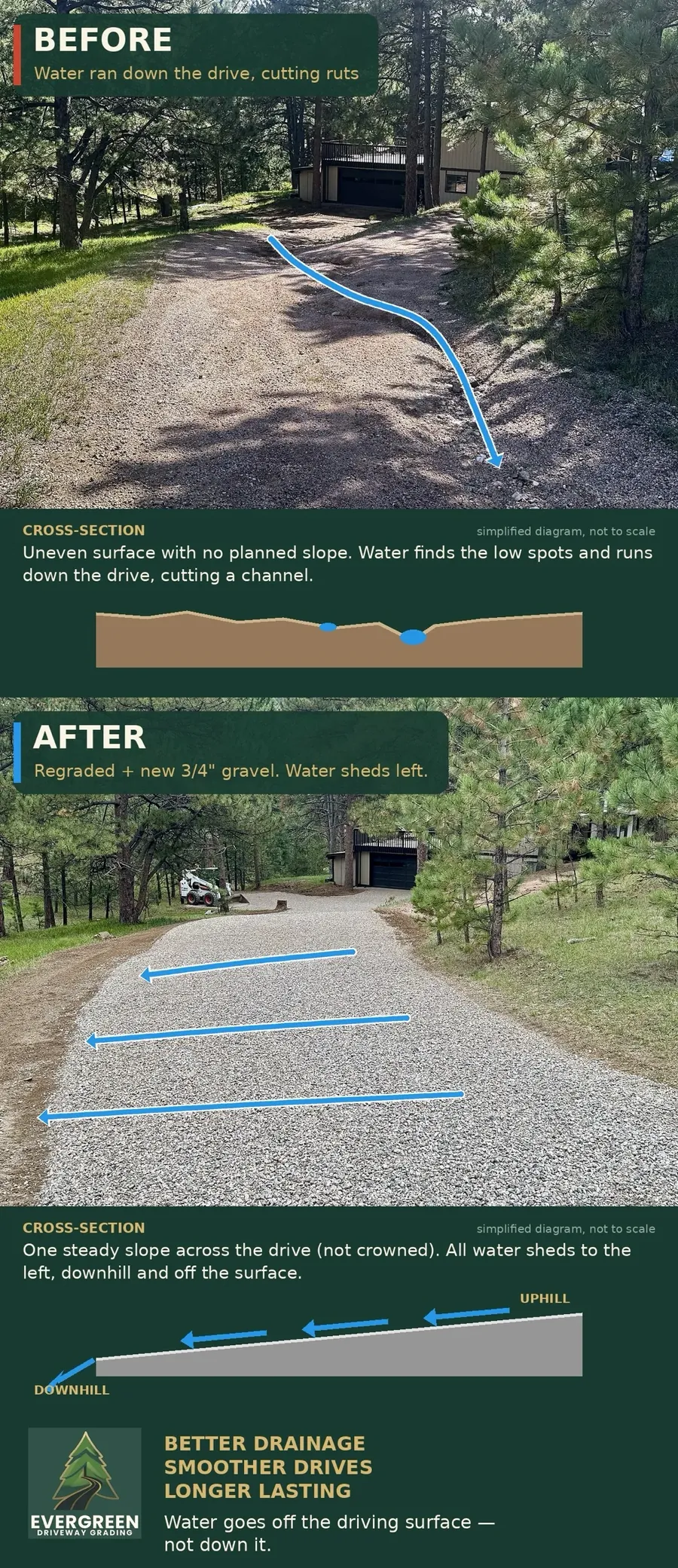
One Evergreen driveway, before and after
Before: the surface had no planned slope. Water found the low spots, ran straight down the driveway and cut a channel along one side.
After: we regraded the driveway with one steady slope across it, toward the downhill side, then put down new three-quarter-inch gravel. Now the water crosses the driveway and leaves it, instead of running down it.
Some driveways do better with a crown that sheds water to both sides. On a hillside like this one, a single slope toward the downhill edge usually works better. The site decides, not a formula.
See this job before and after, from both endsWhat we build to move the water
If it has to do with drainage, we handle it. Getting water off the driveway is only half the job. Once it leaves, it still has to go somewhere without cutting a new gully, so we build for that too. Every site is different, so the fix is designed for the slope, the soil and how much water you're dealing with.
Regrading and cross slope
Reshaping the driveway so water crosses it and leaves, with either a crown or a single slope, whichever suits the site.
Culverts
New, replacement and cleaned-out culverts under the driveway, so water passes under it instead of over it.
Water bars and diversions
Turning water off steep sections before it builds up the speed and volume that cut ruts.
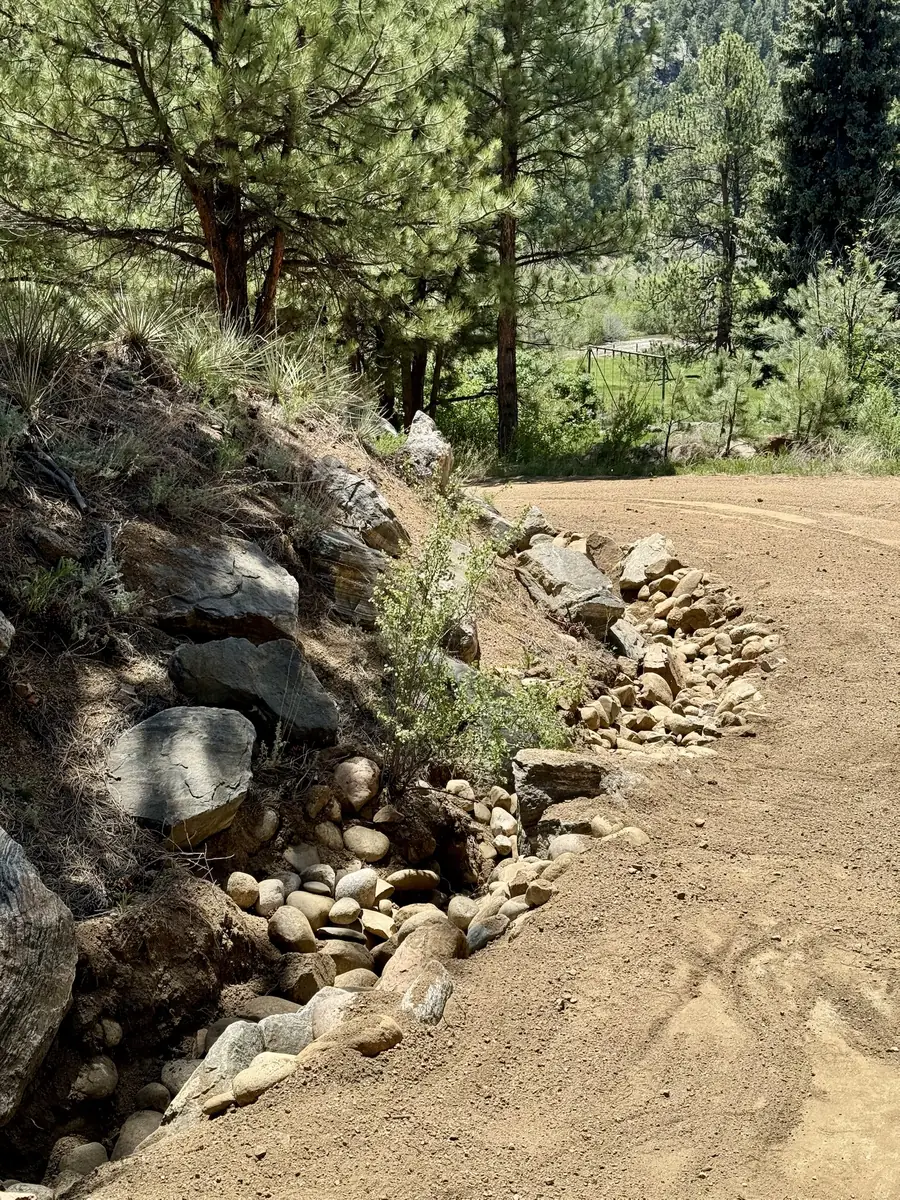
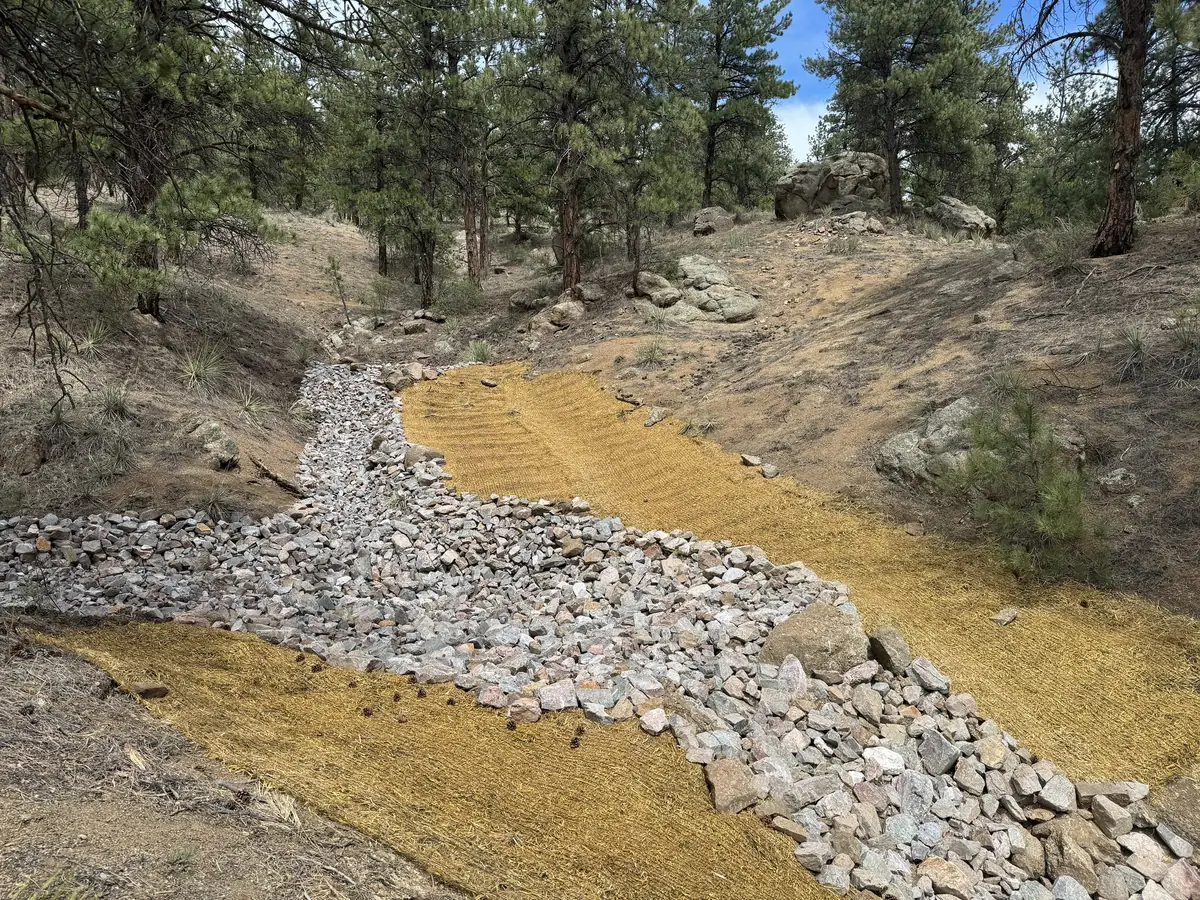
Riprap-lined ditches
Ditches and drainage channels lined with riprap, so fast water has a controlled path away from the driveway without eroding the ground it runs over.
Sediment basins
Basins that slow the water down and catch the soil and gravel it carries, so it doesn't end up in your ditches, culverts or landscape.
Drainage basins and riprap outlets
Riprap-lined basins where water collects and lets go slowly, instead of dumping at the end of a ditch and starting a new washout.
What we do differently
- Drainage first, then base, then surface. New gravel on top of a drainage problem washes out again. We fix the water first.
- We don't just shed the water. We plan where it goes after it leaves the driveway, and build the ditches, basins and riprap to handle it there.
- We supply all the materials. You review the plan and approve the cost. We do the rest.
- Straight talk about maintenance. No mountain driveway is maintenance-free. Our goal is to make your driveway last as long as possible.
Drainage questions
Do you install culverts?
Yes. We install new culverts, replace crushed ones and clean out plugged ones. Where water needs to get from one side of the driveway to the other, a culvert carries it under the driveway instead of letting it run over and cut the surface.
What happens to the water after it leaves the driveway?
That's the part a lot of driveway work skips. We direct it into ditches and channels lined with riprap, and where needed into sediment basins or riprap-lined drainage basins, so it slows down and leaves without eroding your property.
Why does my driveway wash out every summer?
Usually because the water has no planned path off the driveway. Monsoon storms drop a lot of water fast, and it follows the driveway downhill, cutting ruts that get deeper each storm. Fixing the slope and giving the water somewhere to go is what stops it.
Will fixing the drainage end the maintenance?
Not completely. Monsoon storms in the mountains can be severe enough that even a well-designed drainage needs some upkeep. Good drainage keeps that upkeep small instead of a full repair every year.
How much does drainage work cost?
Every mountain driveway is different, so there is no one-size price. Our $550 minimum is for the simplest jobs: a few hours of machine work or hand work, using material already on site, with little or no new material. Most driveways fall between $2,000 and $5,000. Long driveways that need a lot of gravel or recycled asphalt, or bigger drainage work like culverts, basins and riprap, cost more, and the largest projects can reach $50,000. We focus on doing the job right, not on the cheapest version of it. Text a few photos and the rough length, and we will tell you what to expect.
Got a driveway that keeps washing out?
Text a few photos of the ruts and where the water runs, and we will tell you what to expect.
303-276-4500